Taking on your first member of staff is a proud and exciting moment for small business owners, and a sign that a fledgling business is starting to grow into something more mature.
Once the decision is made, there is a lot to think about. What kind of worker do you need, whether that is staff, part-time, contract or freelance; can you afford it; will there be enough work every week to justify the cost; how will you manage recruitment, induction, training and management, let alone making sure you are compliant with tax rules and employment law.
A good place to start is to look at why you have made the decision to expand.
Why am I hiring?
Common signs that more hands on deck are needed are when you cannot keep up with demand, response times to customers are slipping, you are overworking or you are turning down work.
You may also keep getting bogged down in routine or administrative tasks that anybody could do rather than revenue-generating activities. Or you may need skills that you do not have yourself.
Can I afford it?
Each additional employee comes with substantial costs, estimated at about 130% of wages paid. From April 2026 the National Minimum Wage will go up to £12.71 an hour for workers who are 21 and over. For a 35-hour working week this equates to £23,132 a year. Employer’s national insurance (NI) contributions are now 15% of earnings and start at a threshold of £5,000 a year. To take the edge off NI costs, companies receive the employment allowance of £10,500, which they deduct from their NI bill. They must also contribute 3% of wages to eligible employees’ pensions.
To this must be added any direct costs of expanding the workforce such as more tools, another computer, additional licences and employee expenses.
If the figures don’t stack up, using contractors, casual staff or taking on someone part-time will most likely be better options. This is also a good idea if you cannot be certain there is enough work for an extra person, for example, in businesses that have predictable slow and busy periods.
The types of working relationship
UK employment law categorises people as employees, workers and contractors, each coming with different levels of mutual obligation. There is not a hard and fast rule for determining which status applies – rather, in the event of a dispute, the courts look at a number of factors, and have regard to the realities of the employment relationship as well as the letter of the contract.
Contractors usually cost more per hour than staff but they can work out cheaper if not contracted full time; however, legal advice should be sought to ensure people’s status is correct as there are penalties for misclassifying workforce members.
The recruitment process
Just over a quarter (27%) of new recruits failed to turn up on the first day and 41% of new employees had left within 12 weeks of starting a job, according to a Chartered Institute of Professional Development survey from 2024.
These startling figures bring home how important it is to get the recruitment process right. Behind those figures lie many wasted hours spent on drafting ads, interviews, onboarding and training.
Advertising the role
The starting point for finding the right person is the job advertisement, which should make clear what the job involves, the skills required and whether working from home is allowed. Many recruitment ads leave out the salary – while this may give you a larger pool of candidates to choose from, it may also be the case that you will get more applicants with unrealistic salary demands or who do not have the requisite skills.
Be specific about the tasks of the job and give its key responsibilities but don’t overload the job description with desirable attributes – it just reduces the pool of candidates. Furthermore, too many requirements carry the risk of indirect discrimination if some of them place certain individuals at a disadvantage. A good rule of thumb is that if someone can learn a task in the first month it should not be described as essential in the job advertisement.
Do not use language in the advertisement that tends to exclude people: for example, asking for ‘a recent graduate’ will deter older workers from applying or specifying a native English speaker rather than someone with advanced understanding of English could exclude people not born in the UK.
Advertising costs
A LinkedIn promoted listing starts from about £150. Employers advertising on Indeed can expect to pay about £3.80 for each click on their ad and TotalJobs could charge anything from £95 to nearly £399 a listing depending on what level of service is required.
If those prices seem a bit much there are free options such as approaching local colleges, using Facebook groups and spreading the word on your own social media channels.
Shortlisting
While it is straightforward enough to match candidates with the job description do also look at people’s potential. If someone is too exact a match he or she may have done the job before and perhaps is only interested in the job as an interim before finding a more senior role elsewhere. Attitude often can be more important than experience.
The interview
The four ‘Cs’ approach provides a useful framework for assessing new recruits • Culture. Does the candidate align with your company’s values and working style? • Capability: Does he or she have the skills, experience and potential to perform the role effectively? • Compensation: Are the candidate’s salary expectations realistic and aligned with your budget? • Commitment: Does the candidate want a long-term job and the chance to advance in the company?
Try to compare the candidates to the job criteria rather than with each other. It is also good to get at least one other person involved in interviewing to limit any unconscious bias. The candidates should all be asked the same questions. Depending on the role it can be worth opening out the interview process to include practical tasks, role playing for customer relations jobs or problem-solving challenges.
Some questions are off limits, for example, ones relating to health or disabilities, family planning or childcare arrangements and religion. Questions that touch on these are permitted if they relate to a genuine occupational requirement.
The conditional offer
Successful candidates should be told their job title, start date, salary, hours, probationary period and any other conditions. Alongside this employers should be undertaking pre-employment checks and taking up references.
The contract and statement of employment particulars
Once employers are satisfied all is well they should agree the main terms and conditions of the role with the new staff member, which should be in the contract of employment and supplemented by the employee handbook.
The statement of employment particulars also forms part of the contract and should contain in a single document details such as the employer's and employee's names, start date, job title, workplace address, pay details, hours of work, holiday allowance, sick leave arrangements, benefits, notice periods, probationary period and training requirements. It should be provided on or before the first day of work. The employment contract should be provided within two months of the employee’s start date.
While template contracts of employment can be found online it may be worth showing your first statement of employment particulars and contract to a specialist lawyer to ensure it complies with UK law and protects your interests.
Being a good manager
As well as evaluating candidates’ abilities those new to being an employer should also review their own capabilities. Management requires particular skills and attributes, such as good communication, fairness and leadership ability. If there are areas that you are weak or inexperienced in, see what you can do to improve them.
Legal and tax compliance
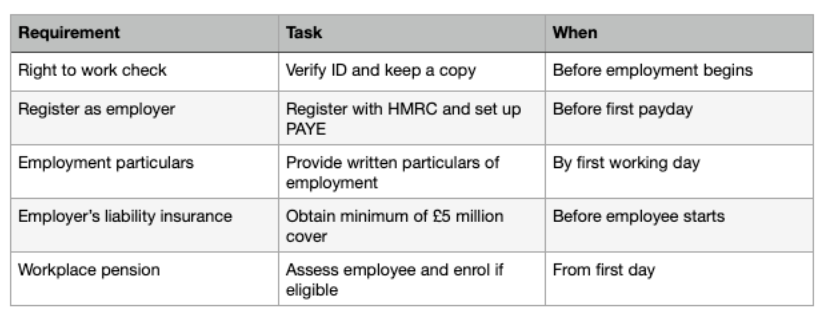
Staying the right side of tax regulations and the law is vital. At worst, failures to carry out right-to-work checks risk penalties of as much as £60,000 and HMRC can also fine employers that breach tax rules. The key requirements for new employees and their timescales are set out below:
DBS
Employees taking on sensitive roles, such as working with children or other vulnerable people, should be vetted with the Disclosure and Barring Service (DBS). Employers can register with DBS if they do more than 100 checks a year or pay an organisation to carry out checks on their behalf.
Employer’s liability insurance
This is a legal requirement and companies can be fined £2,500 a day for not having it. It provides cover for the company against claims by employees and customers if they suffer injury or illness caused by the business or its owner.
HMRC
You need to register as an employer with HMRC when you start employing staff or if using subcontractors for construction work. and setting up payroll. This can take as little as 15 minutes; however, new registrations require an activation code that can take 10 days to arrive. You will be provided with your employer PAYE reference number.
You will need an accountant or payroll software, alternatively HMRC offers its free Basic PAYE Tools software.
Pensions
Generally you will be regarded as an employer if you deduct income tax and national insurance from employees’ wages. Only those who are over 21 years old and who earn more than £10,000 a year need to be auto-enrolled in a pension. The 3% contribution employers are required to make is on top of salary.
There is a choice of providers such as Nest, The People’s Pension and Now Pensions that will set up and run your pension scheme for you.
HMRC can hand out fines to companies that are late with pension contributions or that do not contribute enough.
The first day
Make sure you are ready! It is really disheartening for new employees not to be able to log into systems, or have a workstation set up or access to the tools and equipment that they need. It is no bad thing to ask the employee to come in a bit later on the first day just to make sure you are fully prepared.
Sending a welcome email a few days before the employee starts can be a nice touch. Some time may have passed since the interview and employees will want to be reassured that all is well and may have questions that have arisen since the interview.
Either you or the new employee’s manager should block out some time on the first day for the induction. Clear objectives for the induction period should be established including the provision of any necessary training. A workplace ‘buddy’ or mentor is a good idea – new starters don’t want to have to direct all their questions at their manager – and it frees up the manager from having to provide ad hoc support or training.
Make sure any health and safety issues are covered on the first day, in particular, where fire exits are and any evacuation procedures. If the work involves any machinery or equipment, ensure the employee has the skills to use it and knows the protocol for reporting accidents.
Probationary periods
During their first three or six months new employees should be given regular feedback about their performance. Probationary employees have the same statutory rights as other employees but are likely to have different contractual rights.
Common mistakes
Probably the biggest errors are hiring too quickly or not taking on the right person. Do not rush the recruitment process. If the right candidate doesn’t emerge first time around, try again. Don’t take someone on hoping for the best.
Another bad mistake is overlooking compliance duties. Right-to-work checks and DBS checks must be completed before day one. And late PAYE registration can mean a fine.
Failure to keep proper records can cause problems in the future. Payroll, tax and employments documents should be stored securely from day one.
However, probably the commonest mistakes relate to interpersonal skills. These can be things like: • Inadequate onboarding that assumes employees will just pick things up rather than giving them the structured support and training they need. • Avoiding difficult conversations in the hope that problems will sort themselves out somehow. New starters need timely feedback delivered in a positive way. • Not being clear about expectations. Employees can be left unsure if their work is satisfactory making them anxious and more likely to underperform.
Conclusion
While taking on your first employee should be a reason to celebrate and ought to open the door to further growth it does come with challenges and responsibilities. Furthermore, getting it wrong can cost substantial amounts of money and time.
So if you have unanswered questions and would like more bespoke advice about the tax and financial aspects of taking on staff, please contact Finsbury Robinson.
We offer a full suite of tax, accounting and business advisory services. Our friendly and highly experienced team can be reached on 020 8858 4303 or via email at info@finsburyrobinson.co.uk
Our accountants, tax and business advisors help produce all of our content. If you have any questions on topics raised then don't hesitate to get in touch.